
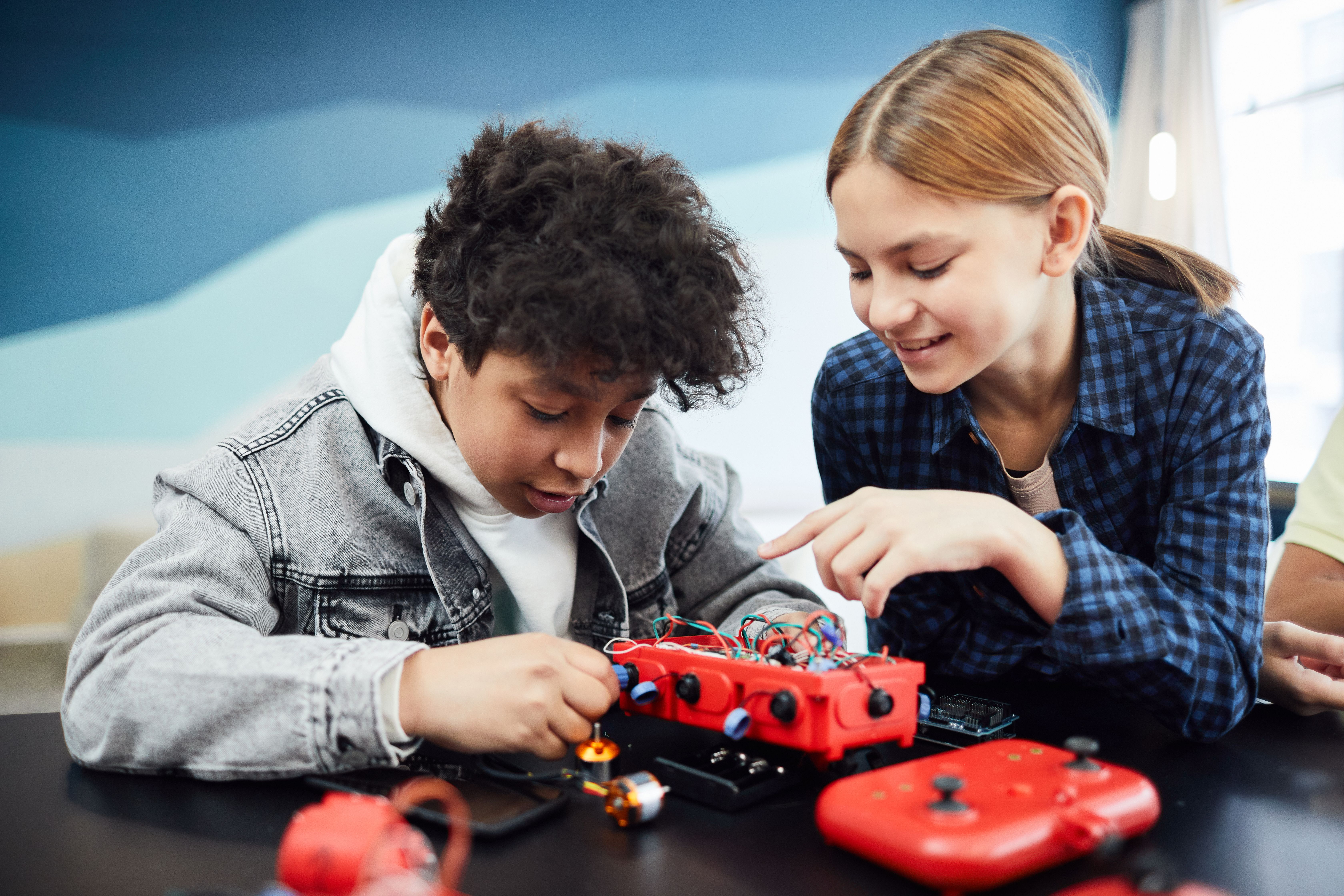
How Robotics Classes Help Houston Kids Build Teamwork
Discover how hands-on robotics classes in Houston help kids practice teamwork, coding, and problem-solving with real take-home projects.
Parents searching for robotics classes for kids in Houston often focus on coding languages, equipment, or STEM grades. But there is another question worth asking: Will my child learn to solve problems with other people? Building a working robot gives children a practical reason to explain ideas, test assumptions, and collaborate.
At LearnToBot, students ages 6–18 explore electronics, coding, and engineering through hands-on projects. Here is why the teamwork behind the robot can matter as much as the finished machine.
Why robotics builds teamwork naturally
A robot rarely works perfectly on the first attempt. Perhaps a motor spins in the wrong direction, a sensor reads an unexpected distance, or a program needs another condition. Each problem creates an opportunity to practice skills that extend beyond technology:
- Communication: Explain what the robot should do and what actually happened.
- Listening: Compare a classmate’s idea with your own.
- Troubleshooting: Change one variable at a time and observe the result.
- Persistence: Treat a failed test as useful information, not a verdict.
- Shared responsibility: Check connections, code, and physical parts before deciding what to fix.
Even when children build individual projects, sharing observations and demonstrating solutions develops the habits used by engineering teams.
What kids can build with real electronics
With microcontrollers such as Arduino, a breadboard, and sensors, students can connect code to physical results. The projects become more engaging because a small change in wiring or logic creates a visible difference.
1. A smart tollway gate
A distance sensor can detect an approaching toy vehicle, while a servo motor raises a barrier. Students can discuss when the gate should open, how long it should stay up, and how to prevent repeated triggering.
2. An RC Explorer
A wheeled robot challenges students to connect motors, control direction, and troubleshoot uneven movement. More advanced students can experiment with wireless controls and different driving behaviors.
3. A heavy-lift crane
A crane built with motors or servos invites questions about movement, mechanical limits, and safe load handling. Students must plan the sequence of actions before writing code.
Each project involves design choices, experiments, and explanations—not just following instructions.
Why the class environment matters
A strong robotics program gives children enough guidance to make progress without taking over the work. LearnToBot emphasizes a 1:5 instructor-to-student ratio, allowing instructors to adapt challenges to each learner’s experience.
Its four-level pathway supports different starting points:
| Level | Typical ages | Learning focus | |---|---|---| | Starter | 6–8 | Circuits, LEDs, buttons, introductory block coding | | Builder | 9–11 | Arduino, sensors, motors, beginner robot behavior | | Creator | 12–14 | Autonomous systems, wireless control, more advanced code | | Master | 15–18 | Python, AI, computer vision, and advanced engineering |
Progress is personalized; ages are a guide, not a rigid placement rule. Parents exploring coding classes for kids in The Woodlands or hands-on STEM options in Katy can look for this combination of real equipment, meaningful challenges, and individualized instruction.
The take-home advantage: learning continues after class
One of LearnToBot’s biggest differences is its take-home robot guarantee: students keep the robots and equipment included in their projects.
That makes it possible to revisit a build after class. A child might demonstrate a working sensor to a parent, repair a loose wire, or improve the code over the weekend. Explaining what changed is another opportunity to strengthen understanding.
LearnToBot also offers camps and school partnerships around Greater Houston, including families exploring robotics education in The Woodlands, Katy, Cypress, and Sugar Land.
Three questions to ask before choosing a robotics class
When comparing programs, ask:
- Will my child build and code real hardware? Look for sensors, circuits, motors, and a functioning project rather than demonstrations alone.
- Who does the troubleshooting? Students should have room to reason, test, and try again with instructor support.
- Can the project come home? Ownership makes practice and family demonstrations easier.
The goal is not simply to finish a robot. It is to help children become creators who can explain how their projects work.
Try hands-on robotics at LearnToBot
Want to see how your child responds to real building and coding? Book a free 45-minute LearnToBot trial class. Your child can explore a hands-on activity while you learn how the curriculum adapts to different ages and skill levels.
Featured stock photograph: Vanessa Loring / Pexels. It illustrates robotics education and does not depict a LearnToBot class.